
 English
 Русский
 简体中文
简体中文How Long Does It Take to Charge an Electric Vehicle? A Comprehensive Guide
As the global shift toward sustainable transportation accelerates, electric vehicles (EVs) have become a mainstream choice for drivers worldwide. One of the most common questions for both new and potential EV owners is: How long does it take to charge an electric car? The answer is not fixed—it depends on multiple key factors, including battery capacity, charger type, vehicle charging limits, and environmental conditions. This guide breaks down everything you need to know about EV charging times, helping you plan daily use and long-distance trips with confidence.
Charging Time Basics: A Simple Calculation
For AC charging scenarios, you can estimate charging time with a straightforward formula:
Charging time (hours) = (Target battery capacity – Current battery capacity) ÷ Charger power (kW)
For example, a 60 kWh battery charged from 20% to 80% using a 7 kW charger:
Energy needed = 60 kWh × (80% – 20%) = 36 kWh
Charging time = 36 kWh ÷ 7 kW ≈ 5.14 hours
This formula provides a rough estimate, but real-world charging times often differ due to charging curve effects, especially during DC fast charging.
Charging Levels: Speed Comparison
EV chargers are divided into three main levels, each delivering distinct power outputs and charging speeds.
Level 1 Charging (Household AC Outlet)
Power output: 2–3 kW
Charging speed: Adds 3–5 miles of range per hour
Full charge time: 8–24 hours
Best for: Emergency backup, low daily mileage, or overnight trickle charging
Level 1 uses standard home power sockets and requires no extra installation, but it is the slowest option, making it impractical for daily full charging of large-battery EVs.
Level 2 Charging (Home & Commercial AC)
Power output: 7–22 kW
Charging speed: Adds 20–73 miles of range per hour
Full charge time: 4–8 hours
Best for: Home charging, workplace parking, shopping centers, and long-stay public lots
Level 2 is the most versatile choice for daily use. A 7 kW Level 2 charger can fully refill a typical 60 kWh battery in about 8 hours—perfect for overnight home charging.
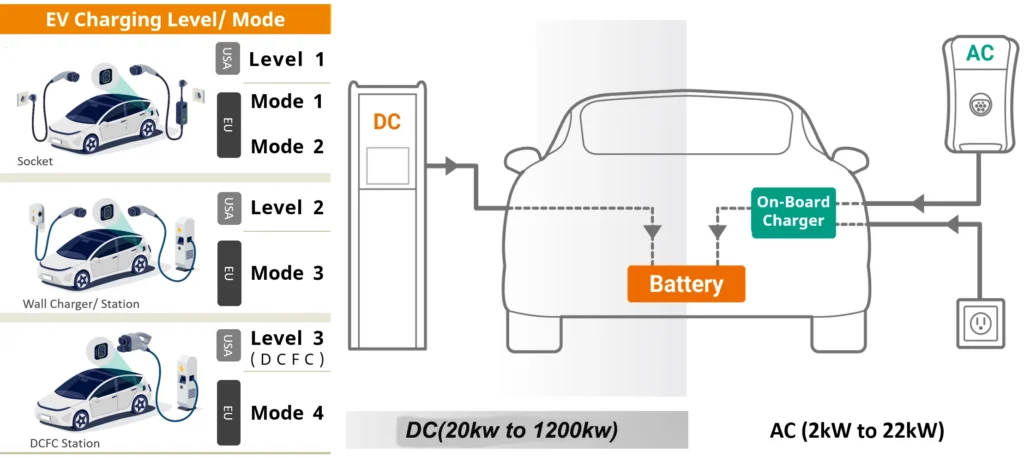
Level 3 Charging (DC Fast Charging)
Power output: 50–360 kW+
Charging speed: Adds 100–1,200 miles of range per hour
Full charge time: 20–60 minutes (0–80%)
Best for: Highway rest stops, busy urban areas, andlong-distance travel DC fast chargers bypass the vehicle’s onboard charger andfeed power directly to the battery, drastically cutting charging time.High-power liquid-cooled ultra-fast chargers can add over 200 km of range in just 5 minutes, ideal for road trips.
Key Factors That Affect EV Charging Time
Charging speed is not only determined by the charger—several variables influence how quickly your EV refuels:
1. Battery Size
Larger batteries store more energy and take longer to charge.A 100 kWh battery will need more time than a 40 kWh battery using the same
charger.
2. State of Charge (SOC)
EV batteries charge fastest when low and slow down as they approach full capacity to protect battery health. Most manufacturers recommend keeping the battery between 20%–80% for daily use to extend lifespan and maintain efficient charging.
3. Vehicle’s Maximum Charging Rate
Every EV has a built-in limit to how much power it can accept. Even if you use a 150 kW fast charger, an EV capped at 50 kW will only charge at 50 kW.
4. Charger Power Output
The station’s maximum power dictates the upper speed limit. A 7 kW charger cannot outpace a 150 kW charger, regardless of the vehicle’s capabilities.
5. Ambient Temperature
Extreme cold or heat reduces charging efficiency. Cold weather requires battery preheating, while hot weather triggers cooling systems—both can slow down charging speed slightly.
6. Charging Curve (Tapering Effect)
DC fast charging shows obvious tapering: speeds peak at low SOC and drop sharply after 80%. The last 20% of charging takes nearly as long as the first 80%, so topping up to 100% at fast stations is rarely necessary.
Practical Charging Recommendations
To optimize your EV charging experience, follow these best practices:
Use Level 2 home chargers for daily overnight charging—convenient and cost-effective.
Rely on DC fast chargers only for long trips to save time and reduce battery stress.
Maintain battery charge between 20%–80% to prolong battery life.
Adopt top-up charging: plug in while parked at work, stores, or gyms instead of waiting for empty.
Preheat or precool the battery in extreme temperatures for faster, more efficient charging.
Conclusion
Charging an electric vehicle can take as little as 20 minutes or as long as 24 hours, depending on your setup and needs. Level 2 home charging fits daily routines, while DC fast charging solves long-distance range anxiety. As charging technology advances—such as high-power liquid-cooled systems—charging times will continue to shorten, making EV ownership even more convenient.
Understanding charging times helps you eliminate range anxiety, plan trips smarter, and fully enjoy the benefits of electric driving. Whether you’re charging at home or on the go, knowing the basics ensures a smooth and efficient EV experience.