
 English
 Русский
 简体中文
简体中文DC Charging solution
With the rapid popularization of electric vehicles (EVs) and the increasing demand for long-distance travel, DC charging solutions have become an indispensable part of the EV charging infrastructure. Different from traditional AC charging, DC charging solutions realize rapid energy replenishment by directly converting grid power into DC power for vehicle batteries, effectively solving the problem of long charging time and promoting the large-scale application of electric vehicles.
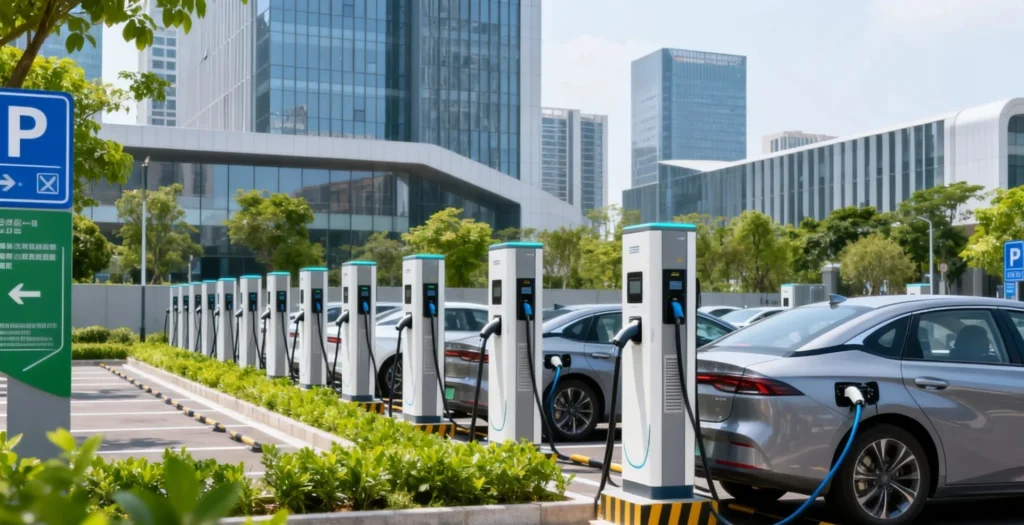
Overview of DC EV Charging Solution
A DC EV charging solution is a high-power rapid charging system designed for electric vehicles of all types, including passenger cars, commercial vehicles, and heavy-duty trucks. Its core function is to convert alternating current (AC) from the power grid into stable direct current (DC) through internal power modules, and then deliver the DC power directly to the EV battery. This bypasses the vehicle’s on-board AC charger, which is relatively slow in conversion, thus significantly improving charging speed and efficiency.
The power range of DC charging solutions is widely adaptable, covering from small portable models to ultra-high-power stations, which can meet the charging needs of different scenarios and vehicle types. The maximum charging power can reach up to 600kW, and the charging time for most electric vehicles can be controlled within 15 to 60 minutes, providing a convenient and efficient charging experience.
Working Principle of DC Charging Solution
The working process of a DC charging solution is simple and efficient, mainly consisting of two core links, which ensures the stability and rapidity of charging:
AC-DC Conversion: The charging system first obtains three-phase AC power from the power grid, and then converts the AC power into DC power through a high-efficiency rectifier and power module. During the conversion process, the system will automatically stabilize the output voltage and current to ensure that it meets the charging requirements of the EV battery.
Direct Battery Charging: The converted stable DC power is directly transmitted to the electric vehicle battery through the charging connector, without passing through the vehicle’s on-board charger. This not only reduces the energy loss caused by secondary conversion but also greatly shortens the charging time, realizing rapid energy replenishment.
Main Types and Technical Specifications
DC charging solutions have various product types, which are divided into different configurations according to installation methods, power levels, and application scenarios. All technical parameters are based on authentic industry standards and practical applications:
Integrated DC Fast Charging Station: Compact all-in-one design (60kW–480kW), suitable for urban public and commercial areas.
Split-System DC Charging Station: Independent power cabinet + multiple terminals (single terminal up to 300kW, total system up to 800kW), ideal for high-traffic areas like highway rest stops.
Mobile DC Charger: Portable (20kW–60kW), for temporary and emergency charging.
Wall-Mounted DC Charging Station: Fixed (30kW–80kW), suitable for communities and office buildings.
Core Advantages and Application Scenarios
Core Advantages
High Charging Speed: Compared with AC Level 1 and Level 2 charging, DC charging is much faster, with a charging time of 15 to 60 minutes for most EVs, effectively solving the problem of range anxiety.
High Reliability: It supports 24/7 continuous operation and is equipped with complete protection mechanisms, including over-voltage, under-voltage, over-temperature, short circuit, leakage, and over-current protection, ensuring the safety and stability of the charging process.
Strong Compatibility: It supports mainstream global charging standards, including CCS, CHAdeMO, and GB/T, and can charge various types of electric vehicles at the same time, with strong versatility.
Intelligent Management: It is fully compatible with OCPP 1.6J and OCPP 2.0 protocols, which can be easily connected to most charging management systems. It supports dynamic load balancing technology to optimize power distribution and improve charging efficiency.
Flexible and Scalable: The modular design allows for flexible expansion of the number of charging terminals and power capacity according to the growth of charging demand, adapting to the long-term development of the charging market.
User-Friendly Operation: It is equipped with a user-friendly interface and supports multiple payment methods, such as RFID cards, mobile APPs, and POS terminals, making the charging process simple and convenient.
Application Scenarios
DC charging solutions are widely used in various scenarios due to their high efficiency and flexibility, mainly including:
Highway rest stops: To meet the rapid charging needs of electric vehicles during long-distance travel.
Urban public charging networks: To supplement the daily charging needs of urban electric vehicle owners.
Large commercial venues: Such as shopping malls and supermarkets, providing charging services for customers while they shop.
Fleet logistics hubs: To meet the centralized charging needs of commercial vehicle fleets, such as buses and trucks.
Emergency and temporary occasions: Using mobile DC chargers to provide emergency charging support for electric vehicles with insufficient power.