
 English
 Русский
 简体中文
简体中文AC Charger solution
AC EV charging solutions are the cornerstone of daily electric vehicle (EV) energy replenishment, widely used in residential, commercial, and public scenarios. Unlike DC charging, AC charging systems do not perform AC-to-DC conversion themselves; instead, they deliver stable alternating current from the power grid to the vehicle, which relies on its on-board charger (OBC) to convert the AC power into DC power for battery charging. This design makes AC charging solutions cost-effective, easy to deploy, and highly compatible with all mainstream EV models on the market.
Core Working Principle
The operation of AC charging solutions is built on a simple yet rigorous technical logic, consisting of three key links to ensure safe and stable charging:
Power Input and Preprocessing: The charging system first obtains AC power from the grid , and processes it through internal filters and voltage stabilization modules to filter out grid interference and ensure the output power meets the standards required by the vehicle’s on-board charger.
Vehicle-Charger Communication and Power Regulation: When the charging gun is inserted into the EV’s charging port, the system establishes communication with the on-board charger to confirm the vehicle’s battery status, charging demand, and compatibility. It then intelligently adjusts the output power (typically 3.6kW to 22kW) based on the vehicle’s on-board charger rating to avoid overloading or inefficient charging.
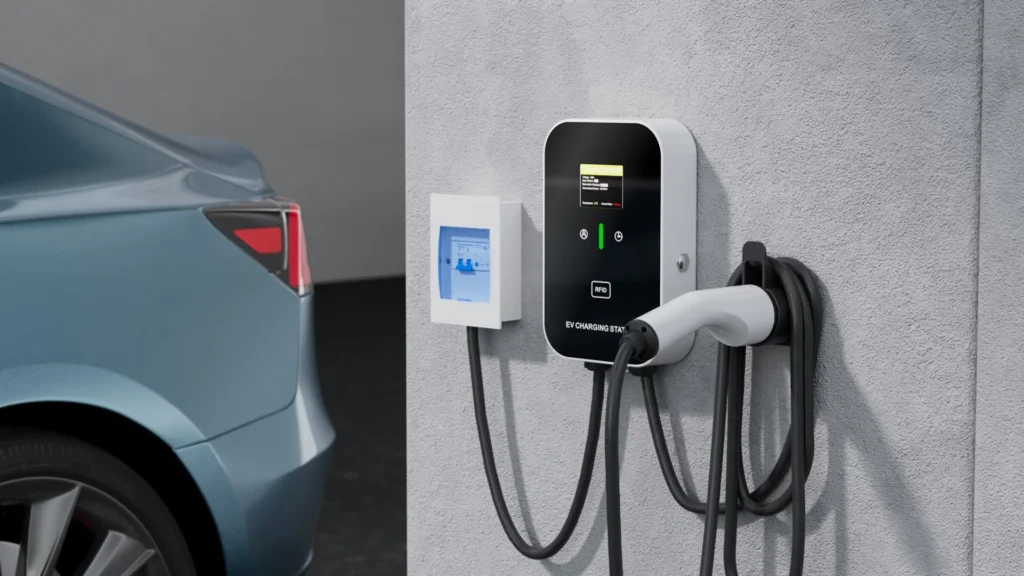
Safety Protection and Full-Process Monitoring: The system is equipped with a complete safety protection mechanism, including leakage protection, over-voltage, over-current, over-temperature, and short-circuit protection, to cut off power immediately in case of abnormalities. It also monitors charging parameters in real time, automatically stopping charging when the battery is fully charged or the connection is disconnected.
Key Features and Technical Specifications
AC charging solutions are designed with practicality and user-friendliness in mind, with the following core features and verified technical parameters:- Stylish and Compact Design:
Breaking away from traditional bulky styling, the design is sleek and low-profile, integrating naturally into residential and public environments. It supports both wall-mounted and floor-mounted installation methods, adapting to different space conditions.
Intuitive Status Indication: Equipped with soft LED indicator lights with color-changing and breathing light effects, it clearly displays the charging status (standby, charging, full, fault) without dazzling glare, ensuring user convenience and comfort.
Easy Operation and Maintenance: The structure is simple, with a user-friendly interface that supports plug-and-charge, RFID card swiping, and mobile app control. Installation and daily maintenance are convenient, requiring no professional technical skills for basic operation.
Wide Compatibility: Adopting global standard connectors such as SAE J1772 and Type 2 (IEC 62196-2), it is compatible with 99% of EV models on the market. The Type 2 connector, in particular, supports both single-phase and three-phase AC power, with a maximum voltage of 480V and a typical power output of 7.2kW (single-phase) to 22kW (three-phase).
Typical Applications
Residential home charging
Office buildings and workplace parking
Communities, shopping malls, and hotels
Long-term parking public areas
Advantages and Industry Significance
AC charging solutions play an irreplaceable role in the EV charging infrastructure, with distinct advantages that make them an essential part of daily EV use:
Cost-Effective: Lower installation and equipment costs compared to DC fast charging stations, making them suitable for large-scale deployment in residential and public areas.
Grid-Friendly: With lower power output, they are easier to integrate into the existing power grid without requiring major grid upgrades, helping to reduce the pressure on grid operation during peak charging periods.
Energy-Saving and Efficient: New national standards require standby power consumption ≤7.0W, and the intelligent sleep function reduces energy waste when there is no charging demand. The full-load efficiency is high, ensuring rational use of grid energy.
Foundation of EV Popularization: As the most accessible and widely deployed charging solution, AC charging solves the daily energy replenishment needs of most EV owners, effectively alleviating range anxiety and promoting the large-scale adoption of electric vehicles.