
 English
 Русский
 简体中文
简体中文A Comprehensive Guide to Electric Vehicle Charging Connectors
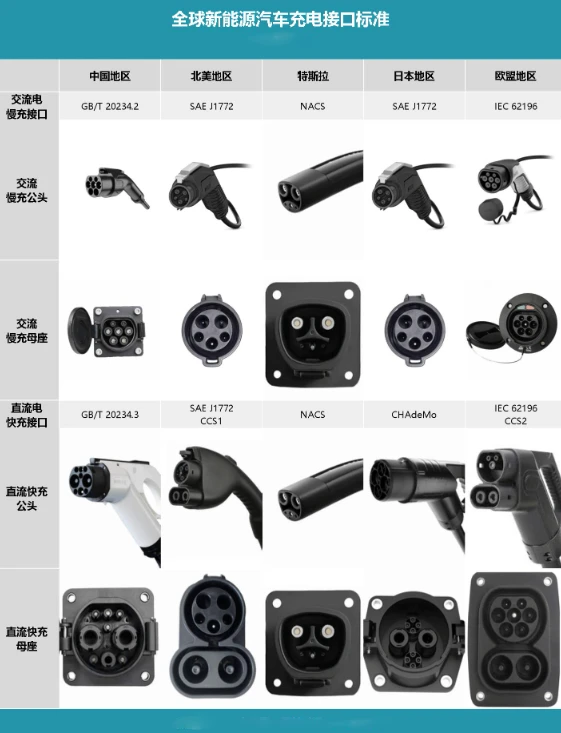
The global electric vehicle (EV) industry relies on a diverse ecosystem of charging connectors, each designed to meet regional standards, power requirements, and vehicle compatibility. These physical interfaces are the critical link between an EV and the charging infrastructure, dictating charging speed, safety, and interoperability.
Broadly, charging connectors are categorized into AC (Alternating Current) and DC (Direct Current) types. AC connectors, used for Level 1 and Level 2 charging, are typically slower, delivering power from 3kW to 22kW, ideal for home, workplace, and destination charging. DC connectors, or Level 3 fast chargers, bypass the vehicle’s on-board charger, directly feeding high-voltage power to the battery at 50kW to 350kW+, enabling rapid top-ups in 15–30 minutes.
North America
SAE J1772 (Type 1): The standard 5-pin AC connector for North American EVs, supporting up to 7.4kW for residential and public Level 2 charging.
CCS1 (Combined Charging System 1): Builds on J1772 by adding two DC pins, enabling DC fast charging up to 350kW.
NACS (North American Charging Standard): Tesla’s compact, all-in-one connector that handles both AC and DC charging (up to 250kW+). It has become the de facto new standard in North America, adopted by Ford, GM, and Rivian.
Europe
Type 2 (Mennekes): The universal 7-pin AC standard across Europe, supporting single/three-phase power up to 43kW.
CCS2: The European DC fast-charging standard, combining Type 2 with two DC pins for up to 350kW charging, compatible with VW, BMW, and Mercedes EVs.
Asia
GB/T (China): China’s national standard includes a 7-pin AC connector and a 9-pin DC connector, supporting up to 400kW ultra-fast charging.
CHAdeMO: A Japanese 10-pin DC standard, once common on Nissan Leafs, now declining globally but still used in older Japanese models.
As the EV market matures, the focus is on ultra-high-power charging and global harmonization. The MCS standard will cater to electric trucks and buses,led by NACS in North America and CCS2 in Europe—are reducing fragmentation. For consumers, this means fewer adapters, faster charging, and greater confidence in cross-region travel—key drivers for mass EV adoption.