
 English
 Русский
 简体中文
简体中文V2G Charging Solution
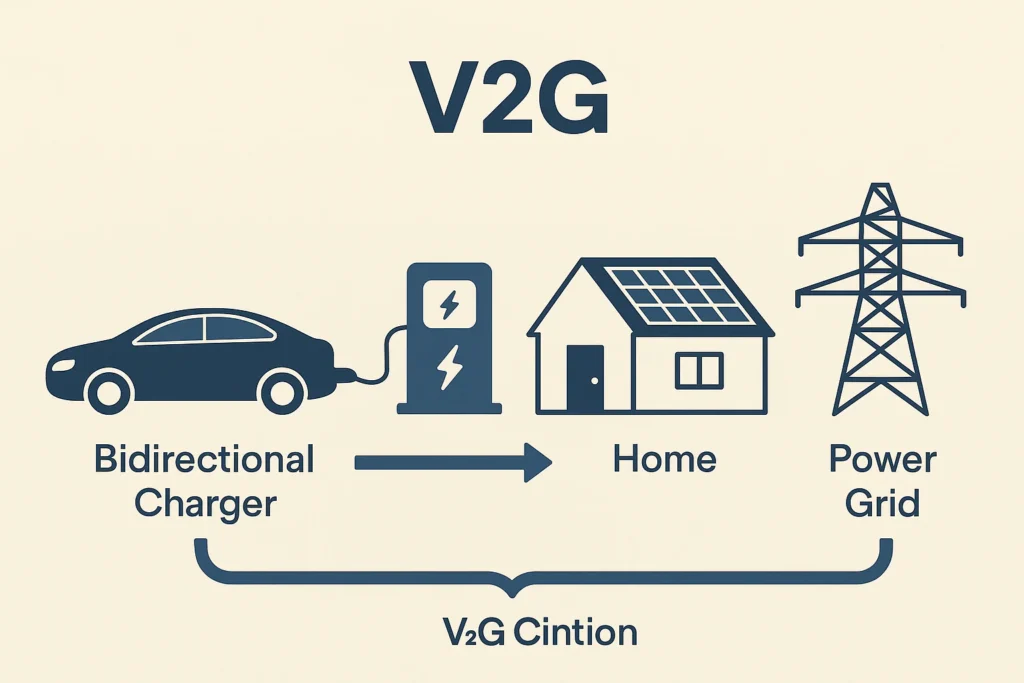
Vehicle-to-Grid (V2G) charging is an innovative smart energy technology enabling bidirectional energy flow between EVs and the grid. Unlike traditional one-way charging, V2G systems not only charge EV batteries from the grid but also let EVs feed surplus energy back to the grid when needed. This turns EVs into “mobile energy storage units,” balancing grid loads, promoting renewable energy integration, and benefiting EV owners economically.
Core Definition and Working Principle
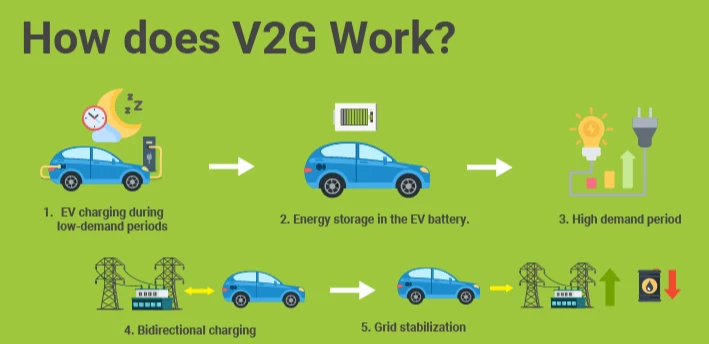
V2G (Vehicle-to-Grid) uses EV batteries as mobile energy storage to realize bidirectional energy exchange with the grid. Its core relies on bidirectional smart charging piles and intelligent control systems, with three key links for safe and efficient interaction:
Bidirectional Energy Conversion: Equipped with a high-efficiency bidirectional converter, the pile converts grid AC to DC for charging and EV battery DC to grid-compliant AC for feedback.
Intelligent Communication and Scheduling: The system communicates in real time with the grid dispatching center and EV on-board system, scheduling charging during grid off-peak periods and discharging during peak periods based on load, battery capacity and user needs.
Safety Protection and Monitoring: Complete protection (over-voltage, over-current, etc.) prevents hazards during conversion, with real-time monitoring of energy flow, battery status and grid parameters to ensure stability.
Key Features and Authentic Technical Specifications
V2G integrates smart grid, energy storage and EV charging technologies, with the following core features and verified technical parameters:
Bidirectional Energy Flow: Supports both G2V charging and V2G discharging for flexible EV-grid interaction.
Intelligent Scheduling: Compatible with OCPP 2.0, it connects to grid dispatching for automatic charging/discharging based on peak-valley prices and grid load.
Wide Compatibility: Adopts CCS, Type 2 and GB/T connectors, compatible with most V2G-enabled EVs, supporting single-phase/three-phase power for diverse scenarios.
Reliable Performance: Complies with IEC 61851-24 and IEEE 1547, IP54+ protection for outdoor use, and 94%-96% full-load efficiency for bidirectional converters.
Typical Parameters: Input/output voltage 220V AC ±10% (single-phase) to 400V AC ±10% (three-phase), 50/60Hz; rated 3.6-22kW; max single EV discharge 300kWh (heavy-duty); Ethernet/4G/WiFi; 4.3-8-inch LCD touchscreen.
Application Scenarios
With growing EV ownership and smart grid advancement, V2G is widely applied in:
Residential Scenarios: Owners charge at low off-peak prices and feed surplus energy back during peaks, covering daily charging and usage costs.
Public and Commercial Scenarios: Deployed in charging stations, malls and offices, it supports grid peak loads, stabilizes operation and brings extra income to operators.
Fleet Scenarios: Suitable for light/medium-duty and heavy-duty EV fleets, centrally scheduled to charge off-peak and discharge peak, reducing costs and aiding grid regulation.
Renewable Energy Integration: Cooperates with solar/wind power, storing surplus energy in EV batteries and feeding it back when renewable output is low to balance volatility.
Advantages and Industry Significance
V2G breaks EVs’ traditional role as “energy consumers,” offering significant advantages for energy and EV industries:
Grid Load Balancing: Reduces grid peak-valley difference, eases peak pressure, and cuts grid expansion needs and social costs.
User Economic Benefits: Owners profit from peak-valley price differences; operators gain from grid regulation, improving charging facility profitability.
Renewable Energy Promotion: As distributed storage, it solves renewable volatility, boosting solar/wind integration and green energy transition.
Smart Grid Construction: Deeply integrates EVs with the smart grid, enriching regulation methods for a more intelligent, efficient power system.
Conclusion
V2G is a key technology connecting EV and energy industries, vital for energy conservation, structure optimization and sustainable development. With bidirectional interaction, intelligent scheduling and wide compatibility, it has broad prospects in residential, commercial, fleet and renewable scenarios. All parameters are based on authentic industry standards and practice. As technology and policies mature, V2G will become a key part of the future smart energy system, transforming energy use and transportation.